 CertWatch
Never chase a lapsed certificate of insurance again.
Track every vendor's certificate of insurance. We chase their agent for renewals so you don't have to.
Free for up to 5 certificates · No credit card required · Cancel anytime

One lapsed COI can cost you five or six figures
If a subcontractor's workers' comp or general liability lapses and you don't have a current certificate on file, your own carrier can treat that vendor as your employee during your annual premium audit — adding their entire payroll to your bill at your rate. A spreadsheet with expiration dates you have to remember to check isn't a system. Emailing agents by hand and hoping they reply isn't either.
Built for any business that hires subcontractors or vendors
If your commercial insurance policy gets audited based on whether your vendors carried their own coverage, CertWatch is for you.
General contractors
Track every subcontractor's workers' comp and GL certificate across every job, in one place.
Property managers & HOAs
Keep landscaping, maintenance, and repair vendors' COIs current without a spreadsheet.
Farms & agricultural operations
Track labor contractors and seasonal vendors' insurance the same way you track everything else on the farm — automatically.
Facilities management companies
One dashboard for every outside vendor's insurance status, instead of a folder of PDFs.
Event venues
Confirm caterers, vendors, and contractors carry coverage before they're back on-site.
Any audited commercial policy
If "uninsured subcontractor" is a line item your insurance auditor could ever write, this is built for you.
Having a certificate isn't the same as being covered
A certificate can be perfectly current and still leave you exposed. CertWatch reads every coverage line on the certificate — not just the expiry date — and tells you when it falls short of what your contract actually requires.
Every coverage line, separately
General liability, auto, umbrella and workers' comp each carry their own limits and their own expiry date. We track them line by line, so when one lapses you know exactly which one — and so does the agent we email about it.
Limits checked against your requirements
Set the minimums your contracts call for — and set different ones by trade, because what you need from a roofer isn't what you need from a landscaper. Anything short is flagged the moment the certificate lands.
Additional insured and waiver of subrogation
The two boxes that decide whether a certificate is worth anything in a claim, checked automatically on every coverage line you require them on.
Is the certificate even made out to you?
A COI naming the wrong entity is worthless, and it's the most common defect there is — usually because the agent reused another client's template. We check the certificate holder box against your legal name on every upload.
The gaps that catch people out
A tracker that only watches expiry dates is watching one of four ways a vendor's coverage quietly stops protecting you.
A policy cancelled mid-term
A certificate proves coverage existed the day it was issued. If the vendor stops paying their premium in month two, that certificate still reads "current" until its renewal date — up to eleven months of false confidence, on exactly the vendors most likely to lapse. Six months in, CertWatch asks the agent one question: is this still in force? If the answer is no, the vendor turns red and you're emailed the same minute.
An additional insured box with nothing behind it
The ACORD form's ADDL INSD column is informational — the form says so itself, in its own disclaimer. The coverage lives in an endorsement attached to the policy. CertWatch reads the endorsement, not the tick box, and catches the case that fools everyone: a real endorsement is attached, and it's scheduled to somebody else.
Coverage that arrives on separate certificates
The workers' comp carrier issues one certificate, the general liability carrier another. Both are filed against the same vendor and neither overwrites the other, so nobody gets chased for a policy they already sent.
Vendors who don't carry everything
A landscaper with no vehicles has no commercial auto. Mark what a vendor doesn't carry, with the reason, and it stops being flagged and stops being chased — while staying on the record as an accepted exception, which is what you actually need at audit time.
Built to survive an audit, not just a spreadsheet
Every document, every version
Nothing is overwritten. Ask what was on file on a given date and you get an as-of-date report for that day — the question that actually gets asked when a claim lands.
A record of every chase
Who was emailed, when, about what, and what came back. Per vendor and across the whole book.
Grouped the way you think
By property, job, project or season. A building with three failing certificates says so without you opening it.
Let vendors add themselves
Send one link — in a contract packet or an email — and the vendor names their own insurance agent. CertWatch takes it from there. They never need an account, and the chasing still goes to the agent, which is the whole point.
How it works
Add your vendors
Enter each vendor's name, their insurance agent's email, and the policy renewal date. Takes seconds.
We email their agent automatically
As the renewal date approaches, CertWatch emails the agent asking for an updated certificate — and keeps following up on a set cadence if the renewal date passes.
You get notified when a new cert lands
The agent uploads the new certificate with a one-click link — no login required for them. You're notified the moment it's on file.
If it's short, we go back and get it fixed
Other trackers show you a red badge and leave the phone call to you. When a certificate arrives that doesn't meet your requirements, CertWatch emails the agent again — naming the exact correction needed — and keeps going until a certificate that does meet them is on file.
See it in action
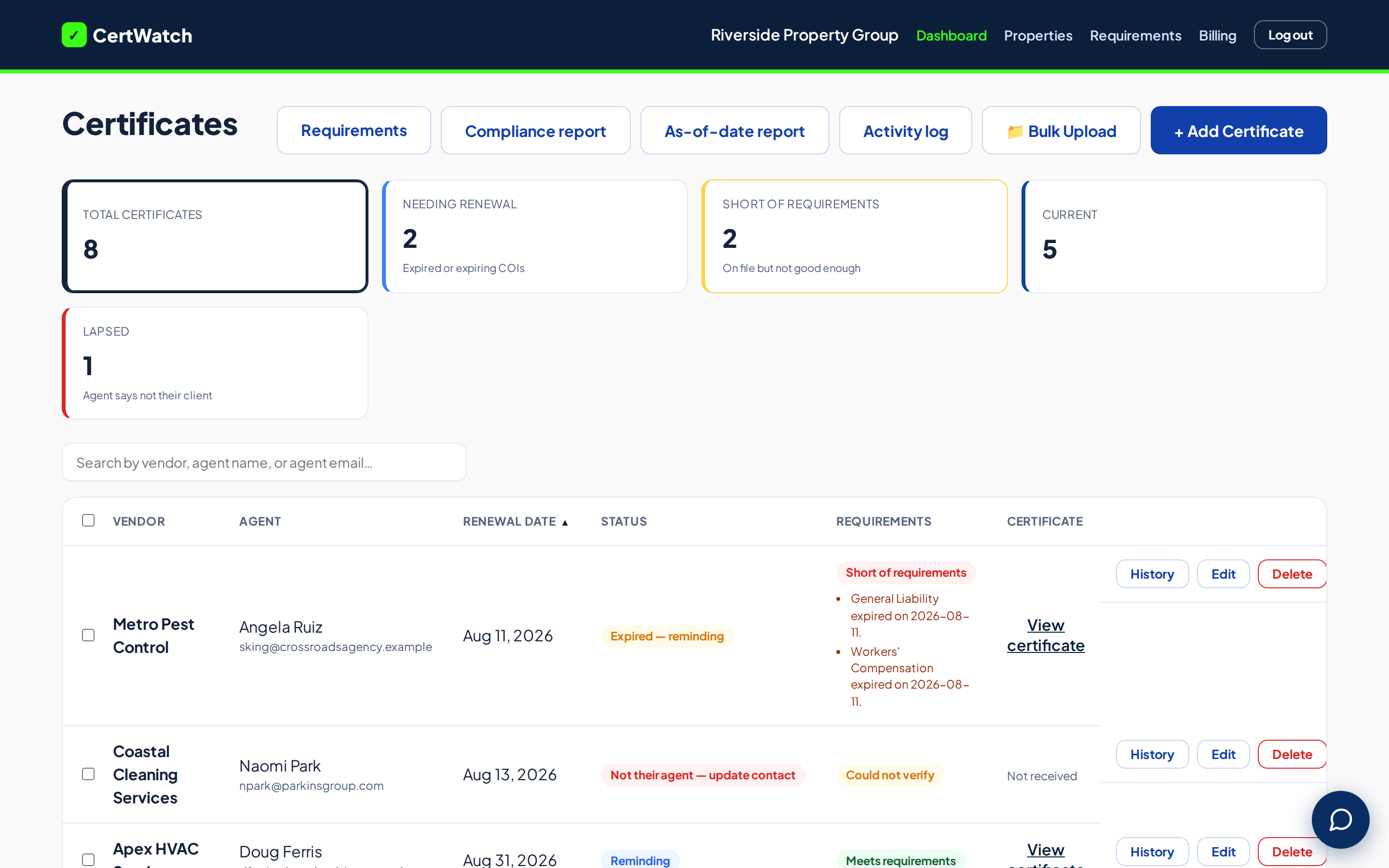
A real CertWatch dashboard — every vendor, its renewal date, and how far along the chase is, at a glance.
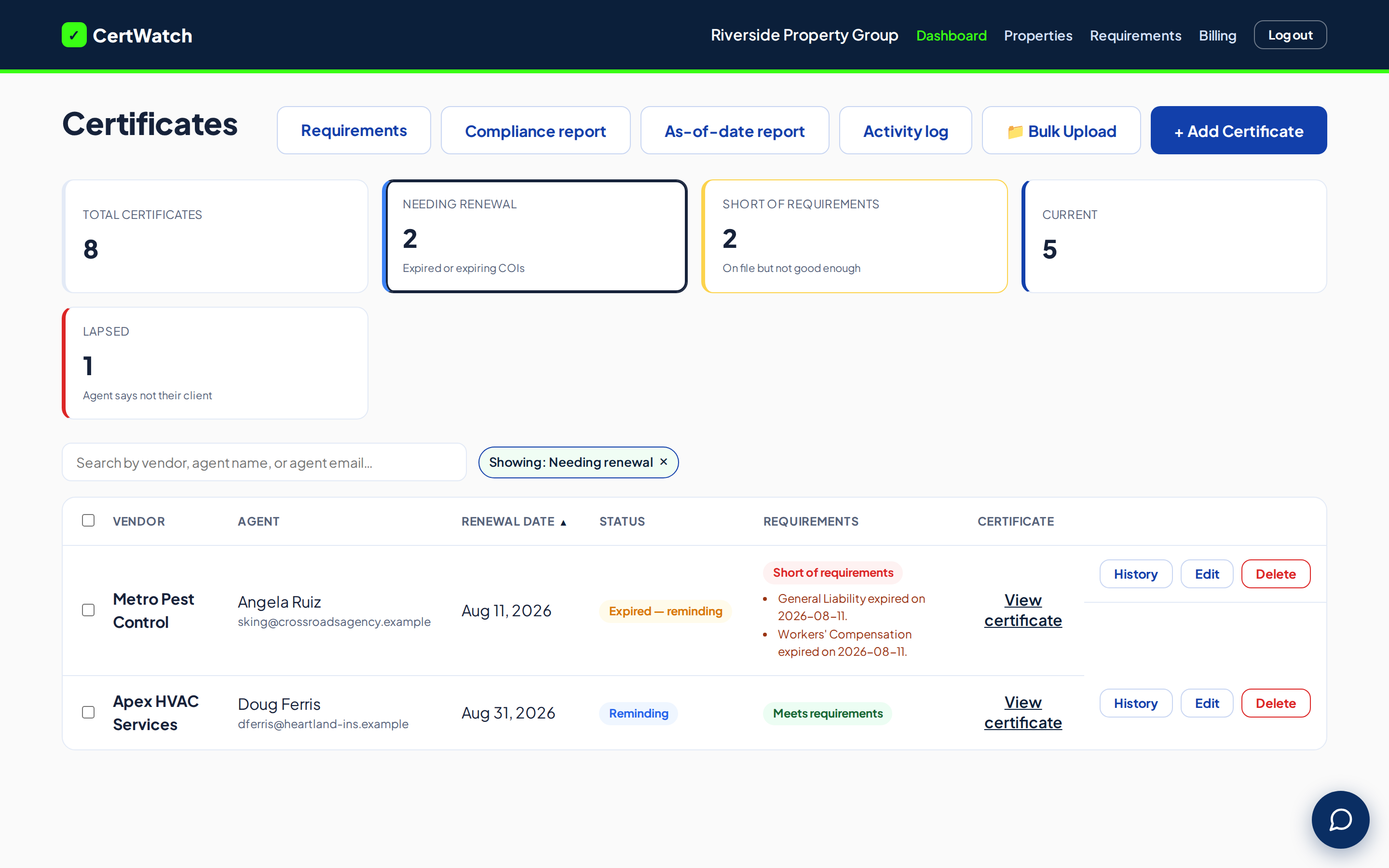
One click filters straight to what needs attention
Click a stat card and the list narrows to exactly those vendors — no digging through a spreadsheet to find who's about to lapse.
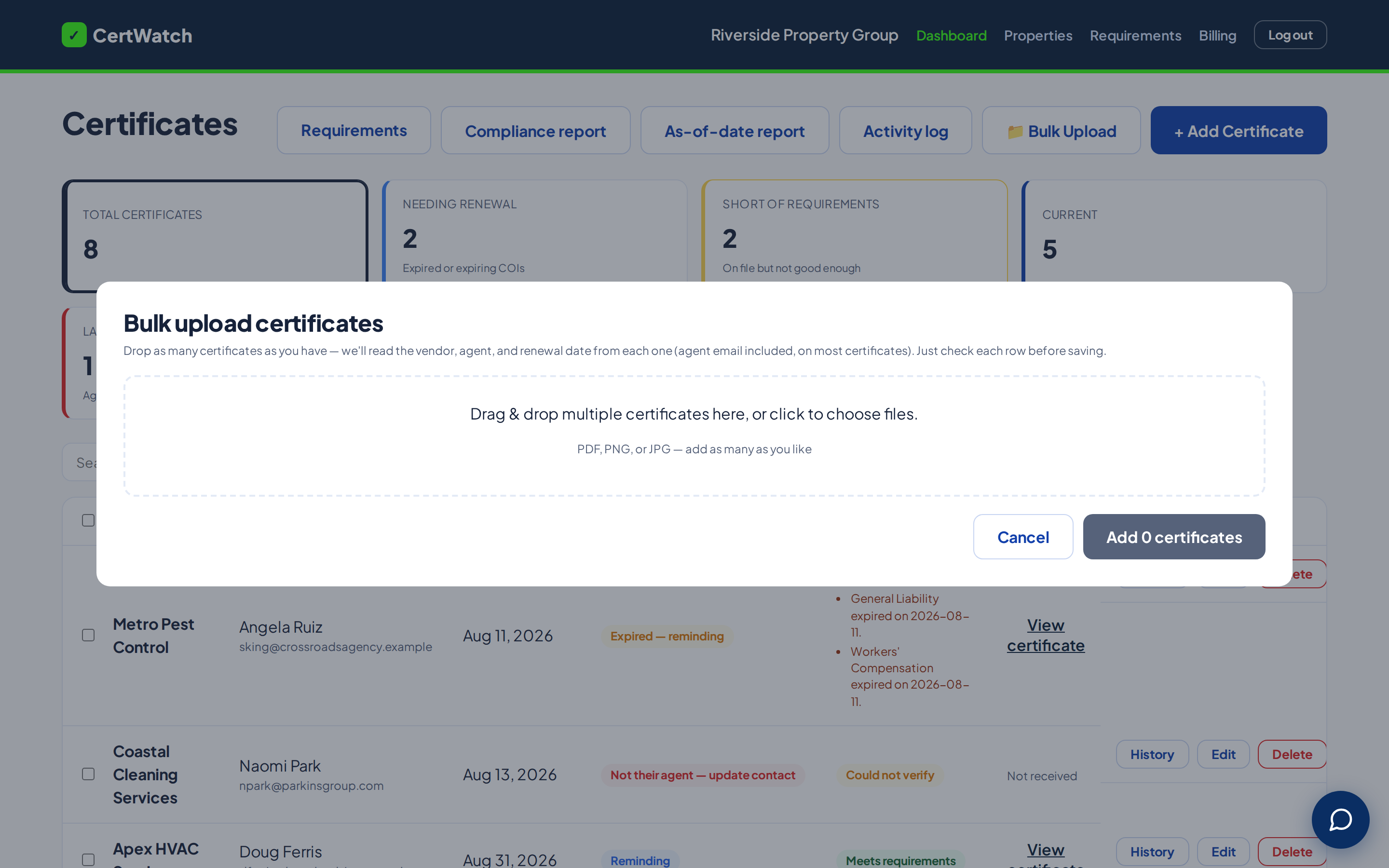
Getting started takes about two minutes
Drop in every current certificate you already have on hand. CertWatch reads each one, sets the renewal date, and starts the clock — no manual data entry.
No credit card required. Most accounts have their first vendor tracked within minutes.
Who's behind this
CertWatch is built and run by Signature Insurance, a licensed independent insurance agency in Lexington, Kentucky, licensed across all 50 states.
That's why this product argues with the ADDL INSD box, knows that a KEMI certificate has no email field, and can tell an each-accident limit from an each-occurrence one. Those distinctions are the difference between software that files PDFs and software that catches the certificate that was never going to protect you. We wrote it because we were doing this work by hand.
It also means that when a vendor of yours turns out to be uninsured, you're one click from people who can actually place the coverage — rather than a support queue that can only tell you the document is still missing.
525 Darby Creek Rd, Unit 29
Lexington, KY 40509
CertWatch is certificate-tracking software. It is not insurance, and using it does not create coverage or alter any policy.
Simple, transparent pricing
Flat monthly plans, no per-vendor fees, no annual minimum. Every plan includes a free 14-day trial.
Frequently asked questions
What is a certificate of insurance (COI) and why do I need to track vendor COIs?
A certificate of insurance is proof that a vendor or subcontractor carries their own workers' compensation and general liability coverage. If a vendor's policy lapses and you don't have a current COI on file, your own insurance carrier can treat that vendor as your employee during a premium audit — adding their full payroll to your bill at your rate.
How is CertWatch different from myCOI, CertFocus, or other COI tracking software?
Most COI tracking platforms price per vendor per year and carry annual minimums (often $1,000+) built for mid-market compliance teams managing hundreds of vendors. CertWatch is flat-rate — free for up to 5 certificates, then $29 to $199 a month covering up to 25, up to 100, or unlimited — built for small and mid-size businesses that just need renewal reminders and agent follow-up to stop, not an enterprise compliance department.
Do my vendors or their insurance agents need to create an account?
No. CertWatch emails the agent directly with a one-click upload link. There is nothing for the vendor or the agent to sign up for or log into — they just reply with the current certificate.
What happens if a vendor's agent doesn't respond?
CertWatch keeps emailing on a set cadence as the renewal date approaches and after it passes, so you don't have to remember to follow up by hand. You're notified the moment a current certificate lands, and the account shows exactly which vendors are still lapsed.
How much does certificate of insurance tracking software cost?
Enterprise COI tracking platforms typically charge $11–$30 per vendor per year, often with a four- or five-figure annual minimum. CertWatch charges a flat monthly fee with no annual minimum instead: the Free plan covers up to 5 certificates at no cost, Starter is $29/mo for up to 25, Growth is $79/mo for up to 100, and Pro is $199/mo for unlimited — with two to three months free on an annual plan.
From the CertWatch resource library